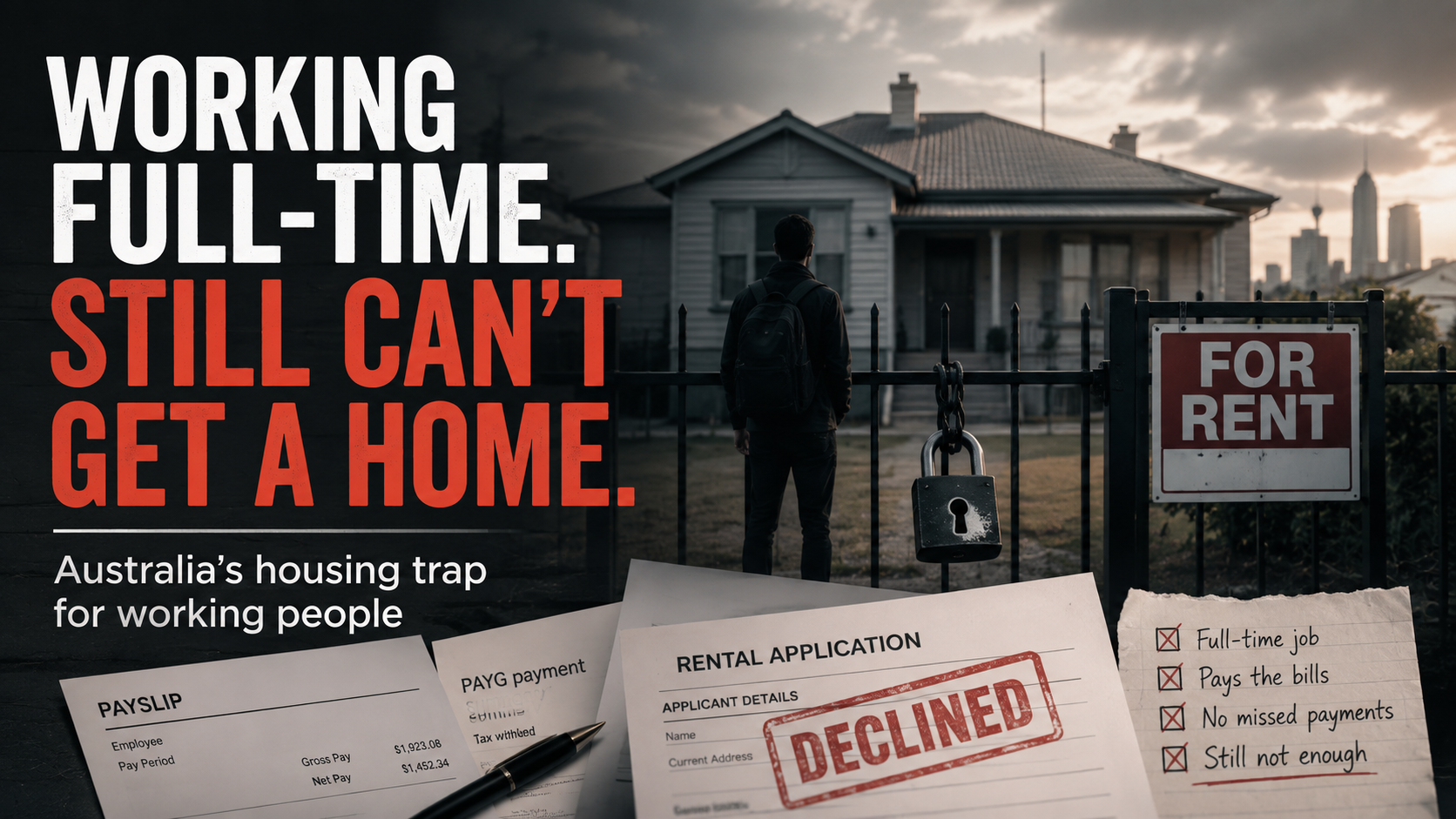
Working Full-Time, Paying Tax—and Still Locked Out of Housing
Australia promises “wealth for toil.” But where is that wealth when a person can work full-time, pay tax every week, and still be told they cannot afford a basic place to live?
I earn too much for social housing.
I apparently earn too little for private rentals.
I earn too much for emergency housing assistance.
So where exactly am I expected to live?
My name is Damien Crane. I am a full-time worker, a father, and someone trying to rebuild stability after a separation.
I am not asking for luxury. I am not looking for a handout so I can avoid working. I am simply trying to find a modest, safe home where I can have some privacy, recover mentally, and provide a suitable place for my children to visit.
Instead, I have discovered a gap in the Australian housing system that seems to have no real answer.
Rejected for earning too much
On 30 July 2026, I received a letter advising that my application for housing assistance had been declined.
The reason given was that my assessed weekly income was $1,521.31, while the income limit for social housing assistance was $845 per week.
I understand that social housing must have eligibility limits. There are people in desperate situations, and housing is limited.
But being above an income threshold does not automatically mean a person can obtain or afford a private rental.
That is where the system begins to fall apart.
Rejected for apparently earning too little
After being told that I earned too much for government housing, I applied for private rental properties.
I was then told that the rent would be considered unaffordable because it exceeded approximately 30 per cent of my weekly income.
My latest payslip showed gross earnings of $1,543.41 and take-home pay of $1,031.41. It also included a temporary $200 weekly staff-loan repayment.
That temporary deduction makes my current payslip look tighter than my long-term financial position will be once the loan is repaid. My employer has also offered to assist with the bond and potentially some initial rent.
Despite permanent employment, regular income, employer support and the willingness to provide references and documentation, I am still being rejected.
The government says I earn too much to need housing assistance, while private agents say I do not earn enough to rent.
That is not a pathway. It is a trap.
The 30 per cent rule does not reflect reality
The idea that rent should remain below 30 per cent of income may look sensible on paper.
But what happens when nearly every available property is above that limit?
People cannot rent homes that do not exist.
In regional towns, rental choices are already limited. Properties priced below $350 per week are extremely difficult to find, and even modest units and houses can be priced well beyond what a single income is considered able to support.
A rigid formula does not account for every person’s real circumstances.
- Temporary deductions that are about to end
- Bond or rent assistance from an employer
- An applicant’s actual spending habits
- Reliable employment history
- The absence of other major expenses
- Personal references and rental history
- The ability to prioritise housing over discretionary spending
Instead of assessing the whole person, applicants can be rejected by a percentage on a spreadsheet.
Working does not protect people from housing instability
There seems to be an outdated belief that homelessness and housing insecurity only affect unemployed people.
That is simply not true.
A person can work full-time and still be unable to obtain housing.
A person can pay tax every week and still live in temporary, unsuitable or mentally exhausting accommodation.
A person can have regular wages and still be one argument, one family breakdown or one notice to leave away from having nowhere appropriate to go.
It can mean couch surfing, staying with relatives, living in a caravan, sleeping in a makeshift space, or remaining in an unstable household simply because there is nowhere affordable to go.
It can mean living around heavy drinking, manipulation, conflict or constant psychological stress.
It can mean having income but no genuine home.
Asking for help and being sent in circles
I contacted housing and homelessness services looking for guidance.
I was told that my income prevented certain services from helping me. I was also told that there was no suitable crisis accommodation available locally for someone in my position.
Again, I understand that emergency services have limited resources and must prioritise people in immediate danger.
But where is the early intervention?
Why must someone become completely homeless before meaningful help becomes available?
Why is there no clear pathway for an employed single father who is living in unstable accommodation, cannot qualify for social housing, and cannot pass private rental affordability tests?
The system appears designed around categories.
If you fall neatly into one, there may be a program.
If you fall between them, you are largely left to solve the problem yourself.
Single men and fathers need support too
There is also a serious shortage of visible, accessible housing support for single men in regional communities.
Fathers do not stop needing stable housing because their children live primarily with the other parent.
A father still needs somewhere safe and appropriate for his children to visit.
He still needs a kitchen, beds, privacy and stability.
He still needs somewhere to recover, work, sleep and maintain his relationship with his children.
Men are often told to speak up, ask for help and take their mental health seriously.
But when they do ask for help, they can find that the services available are limited, distant, income-tested or simply not designed for them.
That needs to change.
I am doing what society tells people to do
I work.
I pay tax.
I am addressing my debts.
I am seeking help where necessary.
I am applying for properties.
I am obtaining references and employer support.
I am trying to improve my life and create a stable home for my children.
What more is a person expected to do before being considered worthy of basic housing?
This is not about demanding a free house.
It is about asking why there is no realistic bridge between social housing and an increasingly unaffordable private market.
There should be practical support for working people who need help establishing a tenancy, including:
- Rental guarantees for suitable applicants
- Government-backed bond and rent assistance
- More affordable regional housing
- Transitional housing for employed people
- Incentives for private landlords to accept supported tenants
- Fairer affordability assessments that consider the complete financial picture
- Dedicated housing pathways for single fathers and men at risk of homelessness
This is bigger than one rejected application
I know I am not the only person facing this.
Across Australia, people are working full-time and still struggling to find somewhere affordable to live.
They are couch surfing, staying in unstable households, living in caravans, returning to unsafe relationships, or remaining in environments that are damaging their mental health because there is nowhere else to go.
These people are not lazy.
They are not refusing to work.
They are not necessarily irresponsible with money.
Many are simply being crushed between stagnant wages, rising rents, limited housing supply and eligibility rules that do not reflect the real world.
My questions for the NSW Government and housing providers
- What is the official pathway for a full-time worker who earns too much for social housing but is repeatedly rejected from private rentals?
- Why are temporary deductions and employer-backed financial support not given greater consideration in affordability assessments?
- What emergency or transitional housing exists for single employed men in regional NSW?
- Why must people reach absolute homelessness before some services can intervene?
- What support exists for separated fathers who need appropriate housing so they can maintain meaningful relationships with their children?
- How can Australia claim to reward hard work when a full-time wage no longer guarantees access to a basic rental home?
I will keep trying—but the system must do better
I am not giving up.
I will continue applying, working, asking around privately and trying to create a stable future.
But persistence should not be used as an excuse for government inaction.
Ordinary working Australians should not have to beg, borrow or become homeless before the system recognises that they need help.
A home is not a luxury.
It is the foundation for physical safety, mental health, employment, parenting and recovery.
Australia may still promise “wealth for toil.”
But for many working people, the reality is toil without security, wages without housing, and taxes without a safety net that catches them before they fall.
That is not good enough.
It is time for the government, housing providers and the private rental industry to stop sending people in circles and start creating a genuine pathway for those trapped in the middle.
Because working full-time should mean a person can afford somewhere to live.
Working Full-Time, Paying Tax—and Still Locked Out of Housing
Australia promises “wealth for toil.”
But where is that wealth when a person can work full-time, pay tax every week, and still be told they cannot afford a basic place to live?
My name is Damien Crane. I am a full-time worker, a father, and someone trying to rebuild stability after a separation. I am not asking for luxury. I am not looking for a handout so I can avoid working. I am simply trying to find a modest, safe home where I can have some privacy, recover mentally, and provide a suitable place for my children to visit.
Instead, I have discovered a gap in the Australian housing system that seems to have no real answer.
I earn too much for social housing.
I apparently earn too little for private rentals.
I earn too much for emergency housing assistance.
So where exactly am I expected to live?
Rejected for earning too much
On 30 July 2026, I received a letter advising that my application for housing assistance had been declined.
The reason given was that my assessed weekly income was $1,521.31, while the income limit for social housing assistance was $845 per week.
I understand that social housing must have eligibility limits. There are people in desperate situations, and housing is limited.
But being above an income threshold does not automatically mean a person can obtain or afford a private rental.
That is where the system begins to fall apart.
Rejected for apparently earning too little
After being told that I earned too much for government housing, I applied for private rental properties.
I was then told that the rent would be considered unaffordable because it exceeded approximately 30 per cent of my weekly income.
My latest payslip showed gross earnings of $1,543.41 and take-home pay of $1,031.41. It also included a temporary $200 weekly repayment for a staff loan.
That temporary deduction makes my current payslip look tighter than my long-term financial position will be once the loan is repaid. My employer has also offered to assist with the bond and potentially some initial rent.
Despite permanent employment, regular income, employer support and the willingness to provide references and documentation, I am still being rejected.
The government says I earn too much to need housing assistance, while private agents say I do not earn enough to rent.
That is not a pathway. It is a trap.
The 30 per cent rule does not reflect reality
The idea that rent should remain below 30 per cent of income may look sensible on paper.
But what happens when nearly every available property is above that limit?
People cannot rent homes that do not exist.
In regional towns, rental choices are already limited. Properties priced below $350 per week are extremely difficult to find, and even modest units and houses can be priced well beyond what a single income is considered able to support.
A rigid formula does not account for every person’s real circumstances.
It may not properly reflect:
- temporary deductions that are about to end;
- bond or rent assistance from an employer;
- an applicant’s actual spending habits;
- reliable employment history;
- the absence of other major expenses;
- personal references and rental history;
- or the ability to prioritise housing over discretionary spending.
Instead of assessing the whole person, applicants can be rejected by a percentage on a spreadsheet.
Working does not protect people from housing instability
There seems to be an outdated belief that homelessness and housing insecurity only affect unemployed people.
That is simply not true.
A person can work full-time and still be unable to obtain housing.
A person can pay tax every week and still live in temporary, unsuitable or mentally exhausting accommodation.
A person can have regular wages and still be one argument, one family breakdown or one notice to leave away from having nowhere appropriate to go.
Housing insecurity is not always visible.
It can mean staying with relatives because there is no other option.
It can mean living around heavy drinking, manipulation, conflict or constant psychological stress.
It can mean sleeping in a caravan, shed, spare room or makeshift space while continuing to get up and go to work every morning.
It can mean having income but no genuine home.
Asking for help and being sent in circles
I contacted housing and homelessness services looking for guidance.
I was told that my income prevented certain services from helping me. I was also told that there was no suitable crisis accommodation available locally for someone in my position.
Again, I understand that emergency services have limited resources and must prioritise people in immediate danger.
But where is the early intervention?
Why must someone become completely homeless before meaningful help becomes available?
Why is there no clear pathway for an employed single father who is living in unstable accommodation, cannot qualify for social housing, and cannot pass private rental affordability tests?
The system appears designed around categories.
If you fall neatly into one, there may be a program.
If you fall between them, you are largely left to solve the problem yourself.
Single men and fathers need support too
There is also a serious shortage of visible, accessible housing support for single men in regional communities.
Fathers do not stop needing stable housing because their children live primarily with the other parent.
A father still needs somewhere safe and appropriate for his children to visit.
He still needs a kitchen, beds, privacy and stability.
He still needs somewhere to recover, work, sleep and maintain his relationship with his children.
Men are often told to speak up, ask for help and take their mental health seriously.
But when they do ask for help, they can find that the services available are limited, distant, income-tested or simply not designed for them.
That needs to change.
I am doing what society tells people to do
I work.
I pay tax.
I am addressing my debts.
I am seeking help where necessary.
I am applying for properties.
I am obtaining references and employer support.
I am trying to improve my life and create a stable home for my children.
What more is a person expected to do before being considered worthy of basic housing?
This is not about demanding a free house.
It is about asking why there is no realistic bridge between social housing and an increasingly unaffordable private market.
There should be practical support for working people who need help establishing a tenancy, including:
- rental guarantees for suitable applicants;
- government-backed bond and rent assistance;
- more affordable regional housing;
- transitional housing for employed people;
- incentives for private landlords to accept supported tenants;
- fairer affordability assessments that consider the complete financial picture;
- and dedicated housing pathways for single fathers and men at risk of homelessness.
This is bigger than one rejected application
I know I am not the only person facing this.
Across Australia, people are working full-time and still struggling to find somewhere affordable to live.
They are couch surfing, staying in unstable households, living in caravans, returning to unsafe relationships, or remaining in environments that are damaging their mental health because there is nowhere else to go.
These people are not lazy.
They are not refusing to work.
They are not necessarily irresponsible with money.
Many are simply being crushed between stagnant wages, rising rents, limited housing supply and eligibility rules that do not reflect the real world.
My questions for the NSW Government and housing providers
I would like the NSW Government, DCJ Housing, private real estate agencies and homelessness organisations to answer some straightforward questions:
- What is the official pathway for a full-time worker who earns too much for social housing but is repeatedly rejected from private rentals?
- Why are temporary deductions and employer-backed financial support not given greater consideration in affordability assessments?
- What emergency or transitional housing exists for single employed men in regional NSW?
- Why must people reach absolute homelessness before some services can intervene?
- What support exists for separated fathers who need appropriate housing so they can maintain meaningful relationships with their children?
- How can Australia claim to reward hard work when a full-time wage no longer guarantees access to a basic rental home?
I will keep trying—but the system must do better
I am not giving up.
I will continue applying, working, asking around privately and trying to create a stable future.
But persistence should not be used as an excuse for government inaction.
Ordinary working Australians should not have to beg, borrow or become homeless before the system recognises that they need help.
A home is not a luxury.
It is the foundation for physical safety, mental health, employment, parenting and recovery.
Australia may still promise “wealth for toil.”
But for many working people, the reality is toil without security, wages without housing, and taxes without a safety net that catches them before they fall.
That is not good enough.
It is time for the government, housing providers and the private rental industry to stop sending people in circles and start creating a genuine pathway for those trapped in the middle.
Because working full-time should mean a person can afford somewhere to live.




Leave a Reply