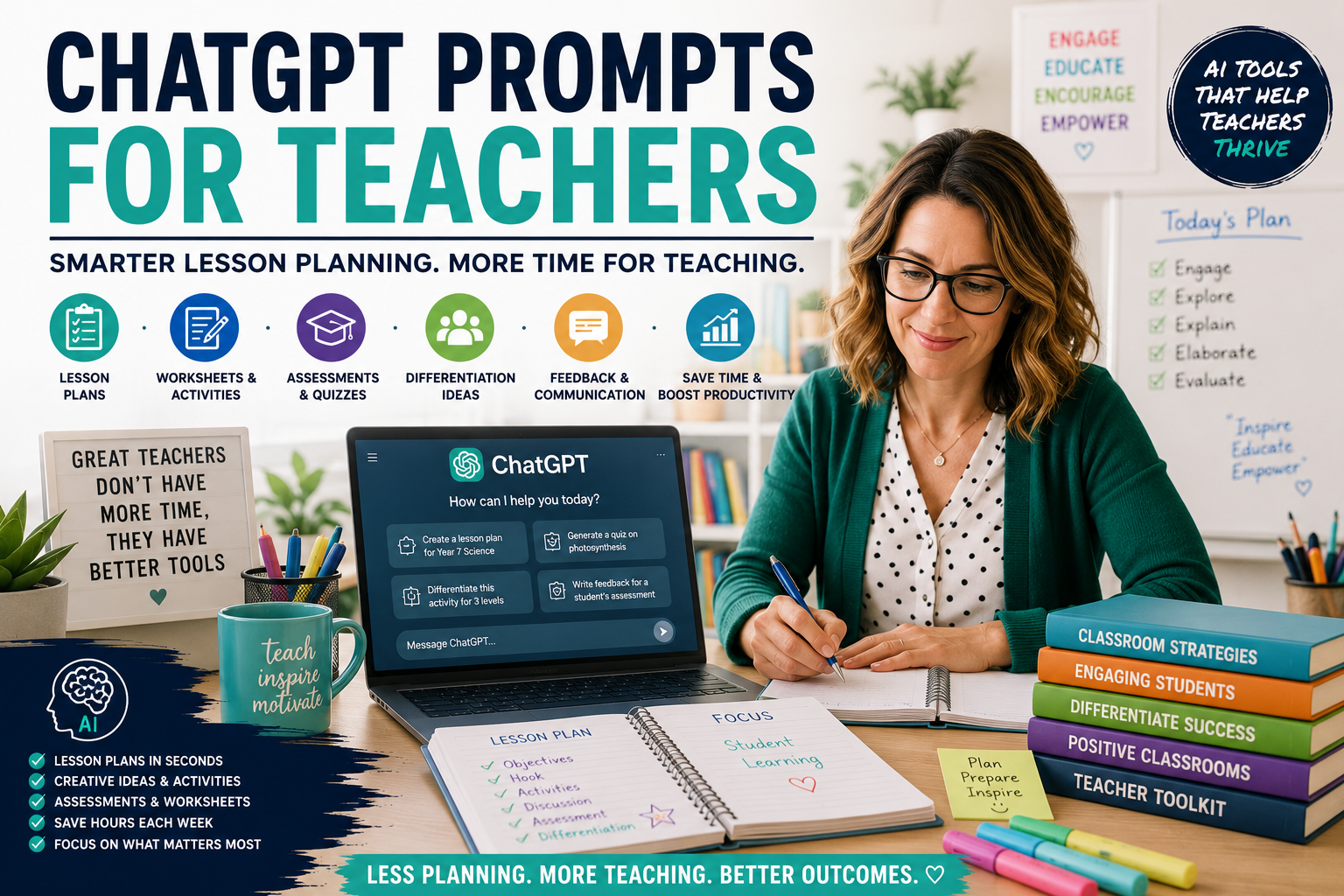
Teaching is one of the most rewarding careers, but it also comes with countless hours of planning, marking, administration, and lesson preparation. Fortunately, artificial intelligence is becoming a practical tool that can help teachers reduce repetitive tasks while freeing up more time for what matters most—supporting students.
ChatGPT isn’t here to replace teachers. Instead, it can act as a teaching assistant that helps generate lesson ideas, create worksheets, prepare quizzes, explain difficult concepts in different ways, and provide inspiration when you’re short on time.
The quality of ChatGPT’s responses depends largely on the quality of your prompts. The more context you provide, the better the results.
In this guide, you’ll find 15 practical ChatGPT prompts designed specifically for teachers. Whether you’re teaching primary school, secondary school, TAFE, university, or adult education, these prompts can help streamline your workflow and spark new ideas.
1. Create a Complete Lesson Plan
Prompt
Create a detailed lesson plan for [subject] aimed at [year level] students. Include learning objectives, classroom activities, discussion questions, practical exercises, homework, and assessment ideas for a [length] lesson.
This prompt provides a strong starting point that you can adapt to suit your class.
2. Differentiate Learning Activities
Prompt
Design three versions of this lesson for beginner, intermediate, and advanced learners while covering the same learning outcomes.
Differentiated learning helps cater to students with varying abilities.
3. Generate a Classroom Quiz
Prompt
Create a classroom quiz on [topic] containing multiple-choice, true/false, short-answer, and extended-response questions. Include a complete answer sheet.
Perfect for revision, homework, or quick knowledge checks.
4. Explain Difficult Concepts
Prompt
Explain [topic] in three different ways: one for younger students, one for teenagers, and one for adults. Include simple real-world examples.
Different students learn differently, and varied explanations can improve understanding.
5. Create Engaging Activities
Prompt
Suggest ten interactive classroom activities that teach [topic] while encouraging teamwork, problem-solving, creativity, and discussion.
Interactive lessons often improve student engagement and participation.
6. Build Assessment Rubrics
Prompt
Create a marking rubric for [assignment] with clear performance levels, marking criteria, and feedback examples.
A well-structured rubric promotes consistency and transparency.
7. Provide Constructive Feedback
Prompt
Generate personalised feedback comments for students who performed at excellent, satisfactory, and developing levels while keeping the tone positive and encouraging.
This can save significant marking time.
8. Write Parent Communication
Prompt
Draft a professional email updating parents about classroom progress, upcoming assessments, and ways they can support learning at home.
Clear communication strengthens home-school partnerships.
9. Design Homework Tasks
Prompt
Create meaningful homework activities for [topic] that reinforce classroom learning without requiring specialised resources.
Practical homework helps students consolidate knowledge.
10. Create Revision Resources
Prompt
Summarise this unit into revision notes, key definitions, important concepts, common mistakes, and sample exam questions.
Excellent for exam preparation.
11. Generate Creative Writing Prompts
Prompt
Create twenty engaging writing prompts suitable for [year level] students that encourage imagination, critical thinking, and discussion.
Creative prompts can be adapted across many subjects.
12. Plan Group Projects
Prompt
Design a collaborative classroom project on [topic] including team roles, timelines, assessment criteria, and presentation ideas.
Group projects build teamwork and communication skills.
13. Make Learning Fun
Prompt
Turn [topic] into an educational game suitable for classroom use with simple rules and learning outcomes.
Gamified learning can increase motivation and participation.
14. Identify Learning Gaps
Prompt
Based on this assessment data, identify likely knowledge gaps, explain why students may be struggling, and recommend targeted classroom interventions.
AI can help teachers recognise patterns more quickly.
15. Generate Extension Activities
Prompt
Create challenging extension activities for gifted students who finish classroom work early while keeping them aligned with the lesson objectives.
Keeping advanced learners engaged benefits the entire classroom.
Tips for Better ChatGPT Results
For the best outcomes, include:
- Student year level.
- Subject area.
- Curriculum or syllabus requirements.
- Lesson duration.
- Learning objectives.
- Available classroom resources.
- Preferred teaching style.
Providing this context allows ChatGPT to generate more relevant and practical suggestions.
Frequently Asked Questions
Can teachers use ChatGPT?
Yes. Many educators use ChatGPT to help prepare lesson plans, create classroom resources, generate quizzes, draft emails, and brainstorm teaching ideas. Final materials should always be reviewed and adapted to suit your students and curriculum.
Does ChatGPT replace teachers?
No. ChatGPT is a productivity tool that supports teachers by reducing repetitive administrative work. Professional judgement, classroom management, and personalised teaching remain essential.
Can ChatGPT create worksheets?
Yes. It can generate worksheets, discussion questions, revision activities, reading comprehension exercises, maths problems, and many other classroom resources.
Is ChatGPT suitable for all subjects?
It can assist with English, mathematics, science, history, geography, business, languages, technology, arts, vocational education, and many other subjects.
Final Thoughts
Teaching has always required creativity, adaptability, and careful planning. ChatGPT won’t replace those qualities, but it can reduce the time spent on repetitive tasks, allowing teachers to focus more on supporting their students.
The prompts in this guide are just the beginning. Experiment with them, customise them for your classroom, and build your own prompt library over time. Small improvements in planning can save hours each week.
If you enjoyed this article, explore our growing collection of AI prompt guides covering students, businesses, bloggers, social media creators, programmers, writers, marketers, and many more.

LEGENDS OF BEZOGIA FULL CINEMATIC TRAILER
it was the wait that was worth waiting for and now it’s finally here. Below you will find the …

1oo Seconds Until Midnight: Doomsday Clock
Doomsday clock now set to 100 seconds to midnight, what does that mean and what happens when the clo…

Bezoge Earth ($BEZOGE)
Bezoge Earth ($BEZOGE) is the first community-run, decentralized meme coin with a real use case. Mem…


Leave a Reply