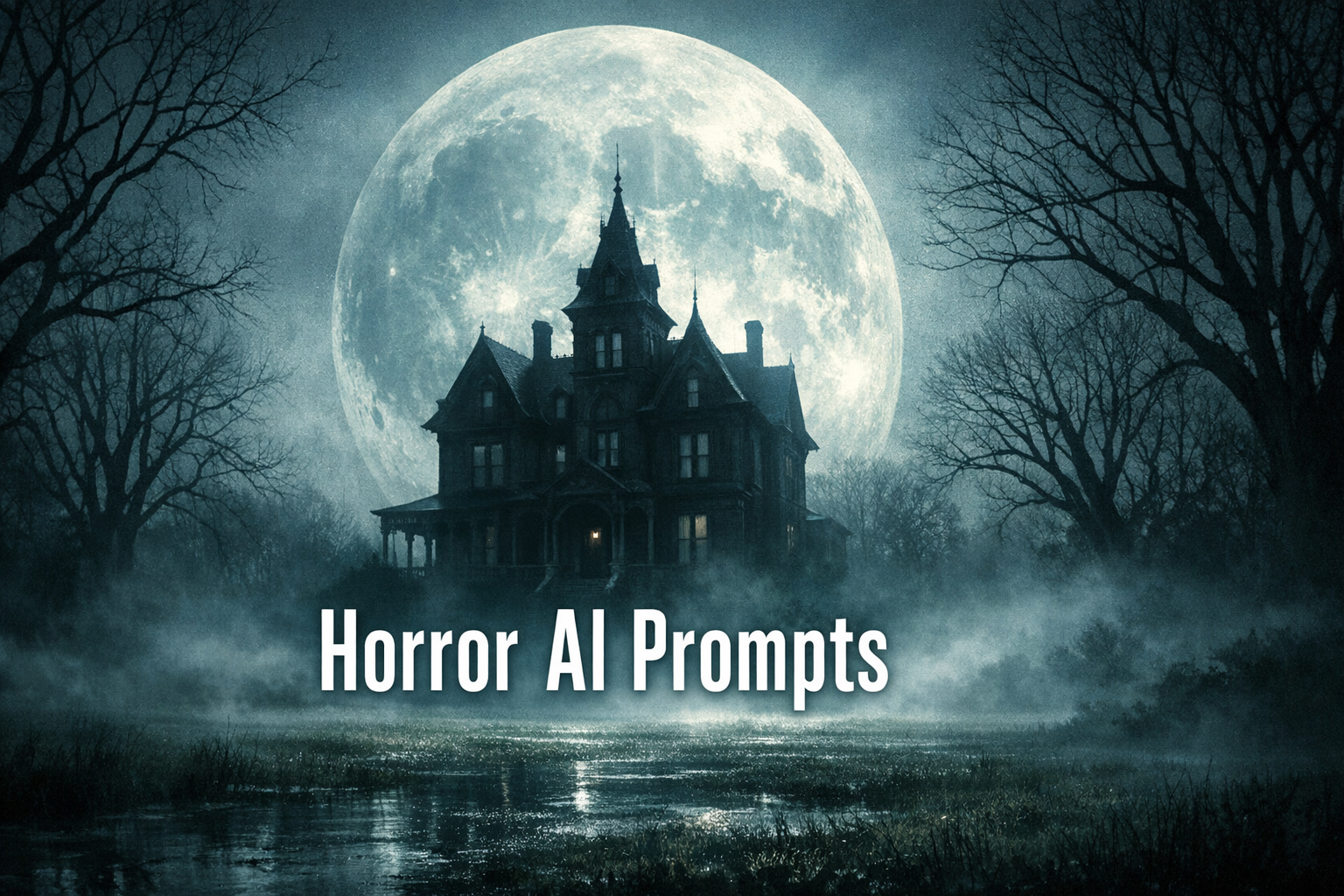
This guide is for creators, indie filmmakers, horror artists and hobbyists who want ready-to-use Horror AI Image Prompts to produce eerie, usable images fast. Whether you work with Midjourney, Stable Diffusion, DALL·E or other text-to-image models, these 25 prompts are crafted to get strong, customisable results while avoiding generic or flat outputs.
Each numbered prompt below includes a short explanation and a copy-and-paste prompt you can drop into your generator. I also cover practical tips for tweaking mood, composition and realism, plus FAQs and related reads from the blog. Use these to prototype concept art, moodboards, book covers or spook your followers.
1. Abandoned Victorian Manor at Moonrise
Classic gothic setting: a crumbling Victorian manor, overgrown gardens and a single broken window glowing in moonlight. Great for book covers or wide establishing shots.
Prompt
Ultra-detailed Victorian manor at moonrise, cracked stone façade, overgrown ivy, crooked wrought-iron gate, heavy fog rolling across wet cobblestones, single dim window with warm amber glow, cinematic wide-angle, moody blue moonlight, film grain, 35mm lens, high dynamic range, photorealistic –ar 16:9 –v 5 –no text, watermark
2. Submerged Church With Ghostly Choir
An underwater horror scene that blends sacred architecture with supernatural elements. Use soft volumetric light for shafts of sunlight filtering through water.
Prompt
Submerged gothic church interior with peeling frescoes, pews half-buried in sand, ghostly choir figures drifting, bioluminescent plankton, shafts of blue-green light, suspended particles, eerie reflections, long exposure feel, ultra-detailed, atmospheric depth –ar 16:9 –no gore, no faces too grotesque
3. Mirror That Shows a Different Room
A psychological horror staple: a mirror that reflects an impossible, older room — hint of someone standing just out of frame for tension.
Prompt
Antique ornate mirror on cracked plaster wall, reflection shows a different Victorian bedroom with peeling wallpaper and a rocking chair slowly moving, dim candlelight, subtle grain, close-up composition, shallow depth of field, cinematic tension, photorealistic –ar 4:5
4. Abandoned Playground at Dawn
Use childish objects in decay to create uncanny unease. Fog, dew and long shadows amplify creepiness.
Prompt
Deserted children’s playground at dawn, rusted swings creaking, old carousel with chipped paint, thick morning fog, dew on spiderwebs, pale cold sunlight, deep shadows, cinematic lensing, high detail, melancholic horror mood –ar 16:9
5. Hospital Corridor with Flickering Lights
Clinical horror works well with sterile but malfunctioning environments. Include subtle motion blur for a sense of unease.
Prompt
Long hospital corridor with peeling linoleum, flickering fluorescent lights, polished but dingy handrails, stretcher parked in shadow, faint overhead signage blurred, cold desaturated palette, cinematic perspective, ultra-realistic, light bloom, slight motion blur –ar 21:9
6. Ragged Doll on a Dusty Bed
Small details make doll images disturbing: mismatched buttons, worn stitches, and a tiny shadow suggesting movement.
Prompt
Worn rag doll sitting on dusty childhood bed, mismatched button eyes, frayed seam down the face, patchwork dress stained with time, afternoon light through dirty curtains, close-up, textured fabric detail, cinematic macro, photorealistic –ar 4:5
7. Forest with Silent Figures Between Trees
Place ambiguous silhouettes in natural settings so the environment feels hostile and observers are unsure whether figures are alive.
Prompt
Misty pine forest at twilight, thin upright humanoid silhouettes barely visible between trunks, low-lying fog hugging roots, cool teal and sepia contrast, high contrast rim lighting, cinematic depth, ultra-detailed bark and undergrowth –ar 16:9
8. Train Station at Midnight with Empty Carriages
Urban isolation: a deserted platform and open carriage doors hinting at departure into the unknown. Use reflective surfaces and wet ground for atmosphere.
Prompt
Deserted 1950s train platform at midnight, empty carriages with open doors, puddles reflecting station lights, faint steam, solitary suitcase on bench, moody cinematic lighting, film noir contrast, ultra-realistic –ar 16:9
9. Portrait of a Faceless Bride
Human forms with altered features trigger deep unease. Keep clothing detail highly realistic to contrast the missing face.
Prompt
Portrait of a bride in vintage lace gown standing in dim parlor, face smooth and featureless like porcelain, intricate lace and fabric textures sharp, candlelight rim lighting, soft film grain, moody chiaroscuro, photorealistic –ar 3:4
10. Distant Lighthouse with Strange Signal
Coastal horror plays on isolation and unnatural signals. Add birds, torn flags and weather for storytelling.
Prompt
Weather-beaten lighthouse on jagged cliffs at storm dusk, unnatural green pulsing light from lantern room, seagulls frozen mid-flight, spray and windblown vegetation, dramatic clouds, cinematic wide-angle, ultra-detailed –ar 16:9
11. Dollhouse Interior Miniature Horrors
Micro-scale scenes let you cram uncanny details into a single frame — play with depth of field and tiny props.
Prompt
Victorian dollhouse interior with tiny furniture, miniature portrait photos with eyes scratched out, dim lamplight, dust motes visible, extreme close-up macro, shallow depth of field, hyper-detailed textures, filmic colour grading –ar 4:5
12. Old Carnival at Night
Derelict carnivals pair bright, once-happy colours with decay. Use coloured lights and broken rides for contrast.
Prompt
Abandoned carnival at night, rusted Ferris wheel half-rotating, torn bunting, faded clown poster with missing smile, multicolour bulbs flickering, dense fog, cinematic neon highlights, ultra-detailed –ar 16:9
13. Corridor of Doors That Lead Nowhere
Corridors and repeating doors create claustrophobia. Vary door styles and add subtle hints behind selected open doors to build narrative.
Prompt
Long narrow corridor lined with mismatched doors, some cracked open revealing darkness, peeling wallpaper, single overhead bulb buzzing, high perspective vanishing point, moody low-key lighting, photorealistic –ar 16:9
14. Antique Camera on Tripod Capturing a Shadow
Make the camera itself an object of dread — an old plate camera with a developing image showing an impossible shadow.
Prompt
Antique large-format camera on wooden tripod in dusty studio, black-and-white print emerging in tray showing elongated shadow figure, warm amber developing light, textured grain, studio dust, cinematic macro, ultra-detailed –ar 4:5
15. Rooftop Figures Watching the City
Silhouette horror is effective at dusk: cloaked watchers overlooking a neon-lit cityscape, ambiguous intent and scale.
Prompt
Three cloaked figures on rain-slick rooftop overlooking neon city at dusk, low camera angle, glinting puddles, distant skyline with smog and sirens, moody cinematic lighting, high detail, photorealistic –ar 21:9
16. Old Nursery with Music Box Song Playing
Childhood objects combined with haunting audio cues (implied in visuals) create deep unease. Show a winding key and floating notes.
Prompt
Abandoned nursery with cracked paint and overturned crib, antique wind-up music box on dusty shelf with faint musical notes visualised as shimmering dust, pale moonlight through blinds, cinematic eerie softness, high detail –ar 4:5
17. Shadow Growing from a Street Lamp
Play with physics: a shadow that grows independent of its source suggests supernatural influence. Use gritty urban textures.
Prompt
Lonely cobblestone lane under single street lamp, shadow on wall stretching and forming a humanoid silhouette without visible source, wet reflections, gritty texture, cinematic low-key lighting, ultra-detailed –ar 16:9
18. Portrait of a Visitor Behind Frosted Glass
Frosted glass silhouettes add mystery and fear without showing explicit features — good for postcards or teaser art.
Prompt
Figure pressed behind frosted glass door, blurred fingertips visible, condensation trails, cold blue interior glow, grainy film texture, close-up composition, moody atmosphere, photorealistic –ar 3:4
19. Clocktower Stopped at Midnight
Time-stopping imagery is symbolic. Show broken gears and a shadowy figure climbing the tower for tension.
Prompt
Ancient clocktower frozen at midnight, exposed brass gears and cracks, shadowy figure climbing gears silhouetted against moon, atmospheric mist, cinematic chiaroscuro, ultra-detailed –ar 16:9
20. Basement Workbench with Strange Experiments
Laboratory horror: scattered notes, jars with preserved specimens and a leaking lamp create curiosity and dread. Keep gore implied rather than explicit.
Prompt
Cluttered basement workbench with glass jars full of ambiguous specimens, hand-scrawled notes, rusted tools, dim yellow lamp casting long shadows, damp stone walls, cinematic texture, high realism –ar 16:9
21. Children’s Drawing That Comes Alive
Animate the uncanny by showing a child’s crude drawing projected as a shadowy presence in the room — perfect for surreal horror.
Prompt
Child’s crayon drawing pinned to nursery wall, shadow of drawing projected three-dimensionally onto floor and creeping up the wall, warm lamplight, textured paper grain, cinematic emotional horror, photorealistic –ar 4:5
22. Silent Opera House with Empty Seats
Empty performance spaces feel uncanny. Show a single spotlight and abandoned prop on stage for narrative weight.
Prompt
Grand opera house with velvet seats empty, single spotlight on cracked grand piano center stage, dust motes in the beam, ornate balcony details, rich film-like colour grade, ultra-detailed –ar 21:9
23. Shadow in the Reflection of a Car Window
Car reflections let you combine the outside world and interior fears. Use wet roads and neon for contrast.
Prompt
Parked vintage sedan on rain-slick street at night, reflection in window shows shadowy figure standing slightly behind, neon signs reflected in chrome, cinematic bokeh highlights, photorealistic –ar 16:9
24. Foggy Marsh with Lanterns Floating
Isolated marshlands with floating lights suggest spirits or lost travellers. Use long exposure and soft glow effects.
Prompt
Misty marsh at night with small floating lanterns drifting above shallow water, reeds silhouetted, pale moonlight, soft glow and long exposure streaks, melancholic eerie mood, cinematic detail –ar 16:9
25. Portrait of a Visitor Under a Wool Blanket
Ambiguous human forms under blankets create primal dread; the focus should be on texture and the suggestion of movement beneath.
Prompt
Figure wrapped under old wool blanket on sagging armchair, faint silhouette of face and hand pressing from beneath, dim lamp casting warm pool of light, richly textured fabric detail, cinematic close-up, photorealistic –ar 4:5
Practical Tips for Using These Prompts
- Tweak the aspect ratio for your use case. Book covers often prefer 4:5 or 3:4, while cinematic widescreen uses 16:9 or 21:9.
- Adjust camera language (e.g. “35mm lens”, “telephoto”, “macro”) to change perspective and depth of field.
- Colour grading matters: teal-and-orange yields cinematic contrast; desaturated bluish palettes give cold dread; sepia suggests age.
- Use negative tokens to avoid unwanted elements: e.g. “–no text, watermark, lowres” for Midjourney-style pipelines or add “no watermark, no logos” for Stable Diffusion UIs.
- Iterate with seed and steps if your tool allows it. Small changes in seed produce varied compositions without losing the core idea.
- Combine prompts for hybrid scenes — merge two numbered prompts if you want more complex narratives (for example, 4 + 12 = playground carnival mash-up).
- Respect ethics: avoid depicting explicit gore or real people in distress. Keep horror atmospheric and suggestive rather than exploitative.
Frequently Asked Questions
Are these prompts safe to use with public AI models?
Yes — the prompts are written to create eerie, atmospheric images without graphic violence. Always follow the terms of service for the model you use and avoid generating images that target real people or contain explicit content.
Which models will these prompts work best with?
These prompts are written generically so they work with Midjourney, Stable Diffusion, DALL·E and similar text-to-image models. You may need to tweak syntax for model-specific tokens (for example, remove “–ar” for DALL·E and instead set the aspect ratio in the UI).
How do I make images more photorealistic?
Add phrases like “photorealistic”, “ultra-detailed”, “film grain”, and specific camera/lens terms. Increase sampling steps or use a realism-focused checkpoint in Stable Diffusion if available.
How do I avoid repetitive or portrait-heavy results?
Vary composition directives: include “wide-angle”, “wide shot”, “close-up” or explicit subject placement like “foreground”, “background”. Use seeds for variety and edit negative prompts to remove duplications.
Can I use these images commercially?
Commercial use depends on the model, licensing and any assets used. Check your chosen model’s commercial terms and, where necessary, run images through a rights filter or create variations that avoid copyrighted styles.
Related published articles
- Grok Imagine Prompts (2026): 25 AI Prompts to Create Stunning Images Fast — techniques for faster image iterations.
- When Your Car Starts Inflating Red Balloons AI Horror Gets Weird — fun examples of AI horror gone strange.
- AI Coffee Cup Dragon – What Was Hiding Inside My Morning Coffee? — playful AI imagery cases you can riff on for surreal horror.
- AI River Dragon | Ordinary River Transforms into a Giant Dragon — inspiration for turning ordinary scenes into monstrous set pieces.
Final thoughts
Horror works best when it hints rather than tells. Use these Horror AI Image Prompts to build mood, test concepts fast and iterate toward images that match your creative vision. Tweak camera language, lighting and colour grading to move from creepy to downright terrifying while staying within ethical boundaries.
If you want a follow-up, I can create variations tuned for specific tools (Midjourney, Stable Diffusion checkpoints, or DALL·E) or produce a downloadable prompt pack for quick use.




Leave a Reply