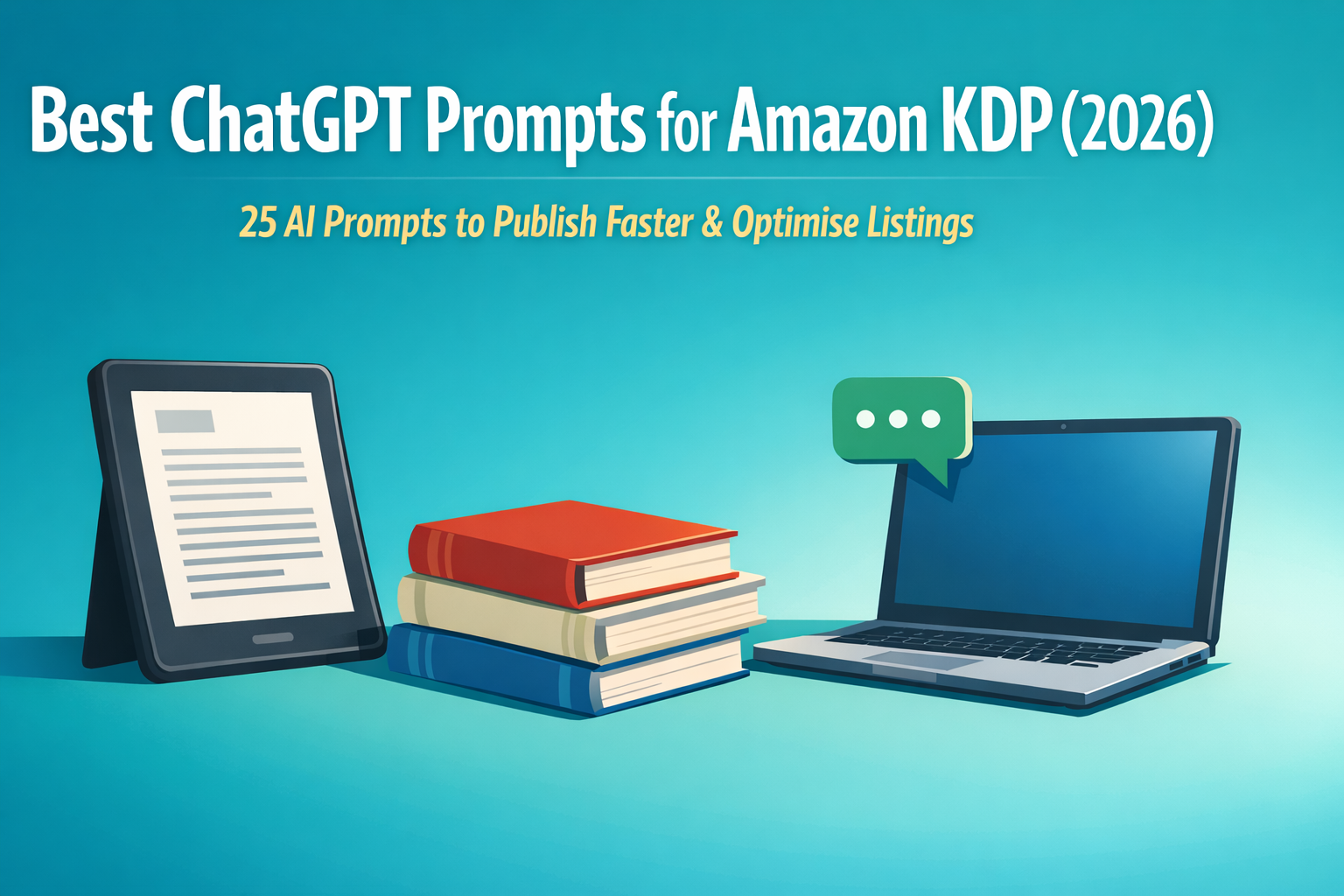
If you’re publishing on Amazon KDP in 2026, this guide is for indie authors, small publishers, and side‑hustle creators who want practical, copy-and-paste ChatGPT prompts to speed up the whole process. The prompts below cover idea validation, outlines, editing, descriptions, cover concepts, listing optimisation and simple marketing copy. Use them with any GPT model, tweak the variables in curly braces, and adapt the output to your brand voice.
How to use these prompts
Start by filling placeholders like {genre}, {target_audience}, {word_count} and {tone}. When a prompt asks for multiple variations, ask ChatGPT for A/B options. Keep your inputs specific — the more context you give (reader age, country, competitors), the better the output. Save prompts you like and iterate: small edits often produce big improvements in titles, blurbs and keywords.
1. Generate profitable book ideas in {genre}
Quickly produce a list of market-fit book ideas with short reasons why each could sell on KDP. Use this at the start of project planning.
Prompt
Act as a market-savvy KDP strategist. Generate 12 commercial book ideas in the {genre} niche for Kindle and paperback. For each idea include: a 6–10 word working title, a one-line hook, expected target audience (age, interests), and three reasons the idea could sell on Amazon KDP in 2026. Highlight any ideas that suit short nonfiction (10k–25k words) for fast turnaround.
2. Competitor analysis and keyword opportunities
Use this to analyse top competitors and surface keyword gaps you can target in titles, subtitles and backend keywords.
Prompt
You’re an Amazon listing analyst. For the keyword phrase “{seed_keyword}”, list the top 5 competing books and summarise: title, price, BSR estimate, notable strengths, common customer complaints from reviews, and three untapped keyword or topic angles I could use to differentiate my book on KDP.
3. Create 10 subtitle options that improve discoverability
Subtitles help with search and conversions. Give options that include long-tail keywords and clear reader benefits.
Prompt
Act as a KDP conversion copywriter. Generate 10 subtitle options for a book titled “{working_title}” targeted at {target_audience}. Each subtitle should be 6–12 words, include a relevant long-tail keyword, and state a clear outcome or benefit.
4. Write a high-converting Amazon book description
Get a description formatted for Amazon (short hook, benefits, social proof, call to action). Ask for both A+ long form and short blurb.
Prompt
You’re an Amazon book description expert. Write two versions for the book “{final_title}” — (A) a short blurb up to 300 characters for the Kindle description preview, and (B) a full long description (up to 1500 characters) using HTML paragraphs and bold tags for key benefits. Keep tone {tone} and include a 1-line author credibility blurb and a clear call to action to “Buy now”.
5. Draft a practical book outline with chapter summaries
Generate a chapter-by-chapter plan with word counts and a 1–2 sentence summary per chapter.
Prompt
Act as an experienced book editor. Create a 10-chapter outline for a {word_count}-word non-fiction book on {topic}. For each chapter include: chapter title, 150–250 word summary, 3 subpoints to cover, and suggested word count range.
6. Turn an outline into the first 1,000 words
Use this to get a strong opening that you can revise and expand.
Prompt
You’re a professional book writer. Using this chapter summary: “{chapter_summary}”, write the first 1,000 words of the chapter in {tone}. Keep paragraphs short, include a relatable anecdote or example, and finish with a clear transition to the next chapter.
7. Produce 5 punchy chapter titles for a short nonfiction book
Short books need clear, compelling chapter titles. This prompt returns several styles so you can choose.
Prompt
Generate 5 different sets of chapter titles (10 chapters each) for a short nonfiction book about {topic}. Provide variations: descriptive, benefit-focused, curiosity-driven, and playful. Label each set so I can choose a style quickly.
8. Proofread and copyedit a chapter
Paste a chapter and get grammar fixes, clarity edits and a short note about tone consistency.
Prompt
I will paste a chapter below. Act as a developmental copyeditor. Correct grammar, tighten sentences, improve readability, and suggest 5 changes to improve flow and reader engagement. Preserve the author’s voice and note anything that may need fact-checking.
9. Create 20 backend keyword suggestions for KDP
Generate keyword strings that fit Amazon’s backend fields and target search intent.
Prompt
As an Amazon KDP keyword specialist, create 20 backend keyword suggestions (single words and compound phrases, no commas) for a book about “{topic}” targeting readers who search for {seed_keyword}. Prioritise relevance and low-to-moderate competition phrases.
10. Suggest 7 Amazon categories and category pairings
Categories can be tricky. This prompt suggests primary and secondary categories and reasoning.
Prompt
You’re an Amazon category expert. Recommend 7 suitable KDP categories (including subcategories where possible) for a book about “{topic}” and explain why each is a good fit. Suggest one primary and one secondary category pairing optimised for discoverability.
11. Generate 12 subtitle variations for A/B testing
Useful for split-testing on Amazon Ads and product listing. Offer measurable differences.
Prompt
Create 12 subtitle variations for A/B testing for the title “{final_title}”. Label each with expected focus (keyword, benefit, curiosity, authority) and a one-line rationale for why it might improve clicks.
12. Write 6 short ad headlines and descriptions for Amazon Ads
Ads need punchy copy. These are short headlines and 2-line descriptions optimised for click-through.
Prompt
As a direct response copywriter, write 6 ad headlines (max 50 characters) and corresponding 90-character descriptions for promoting “{final_title}” on Amazon Ads. Use urgency or benefit-focused angles and keep tone {tone}.
13. Create a Midjourney prompt for a KDP cover concept
For cover designers using AI image tools. Keep visible text minimal on the image.
Prompt
Write a Midjourney-style image prompt for a book cover for “{final_title}” in the {genre} genre. Include: main visual elements, colour palette, mood, style reference (e.g., bold minimalist, photo-real, illustrated), and keep visible headline text short: “{cover_headline}”. Add instructions for spine and back cover colour harmony and leave room for title and author name.
14. Craft a compelling author bio for the KDP page
Short bio that builds trust and fits Amazon’s author page conventions.
Prompt
Write a 2-sentence author bio and a 75–120 word extended bio suitable for the Amazon author page for {author_name}. Mention key credentials, relevant experience, and one personal detail to make the author relatable. Keep tone professional but approachable.
15. Generate 8 subtitle plus description combos for niche audiences
Target different reader segments with specific messaging and benefits.
Prompt
Create 8 subtitle and 1-sentence description combos for the book “{final_title}”, each aimed at a different niche audience (e.g., parents, small business owners, students, retirees). Include an angle and one key benefit tailored to each audience.
16. Convert a nonfiction chapter into a checklist or workbook
Turn content into actionable worksheets or checklists for readers.
Prompt
Transform this chapter summary into a practical 10-step checklist and a short 5-question workbook exercise for readers to apply the chapter’s lessons. Keep language actionable and include suggested time to complete each step.
17. Localise the book listing for US, UK and Australian markets
Adjust language, spellings and cultural references for three major markets.
Prompt
As an international copy editor, rewrite the book title, subtitle and a 150-word description for the US, UK and Australian markets. Adjust spelling, idioms, measurements and any cultural references so each version reads naturally to that audience.
18. Produce an audiobook script conversion checklist
Practical checklist for turning text into an audiobook, including narration tips and timing markers.
Prompt
Act as an audiobook producer. Create a checklist and brief script-editing guide for converting a 40k-word non-fiction book into a narrated audiobook. Include notes on pacing, parenthetical directions, chapter intros, and recommended file formats and sample rates.
19. Write 10 review request email templates
Polite, GDPR-friendly templates for asking readers to leave reviews or give feedback.
Prompt
Generate 10 polite review request email templates tailored to: readers who bought the book, ARC readers, newsletter subscribers, and podcast guests. Keep them short, personalise tokens like {first_name}, and include a simple call to action for leaving a review on Amazon.
20. Suggest a pricing strategy and launch plan
Strategic launch plan including KDP Select considerations, promo timing and price points.
Prompt
You’re a KDP launch strategist. Recommend a 6-week launch plan for a {genre} book priced at {price}. Include whether to use KDP Select, suggested early discount days, promotional tactics, timeline for email and ad activity, and three metrics to track post-launch.
21. Create 15 social captions for launch week
Ready-to-post social copy for X, Facebook and Instagram launch posts. Keep them natural and varied.
Prompt
Write 15 short social media captions for launch week promoting “{final_title}”. Provide 5 for X, 5 for Facebook, and 5 Instagram captions with suggested hashtags. Keep captions friendly and concise and include 2 variants that promote an early discount.
22. Rewrite negative reviews into learning points
Use poor reviews as product development feedback to improve future editions.
Prompt
I will paste three negative reviews. Analyse each review and rewrite it as 1) a neutral summary of the complaint, 2) one actionable fix for the next edition, and 3) one positive spin I could use in marketing (honest improvement statement).
23. Create a short press release for local media
Simple press release template targeted at local newspapers and podcasts.
Prompt
Write a 300-word press release announcing the launch of “{final_title}” aimed at local Aussie media and podcasts. Include a compelling lead, a quote from the author, why the book matters locally, and contact information for interview requests.
24. Generate long-form content ideas to support the book
Ideas for blog posts, videos and lead magnets that drive book discoverability.
Prompt
List 12 content ideas (blog posts, short videos, lead magnets) that support the themes of “{final_title}”. For each idea provide: suggested format, a working headline, target platform, and one call to action that promotes the book.
25. Produce a short “About the Book” blurb for retail partners
Concise copy used for retailer pages, events and bulk order pitches.
Prompt
Write a 50–75 word “About the Book” blurb suitable for retail partners and event listings for “{final_title}”. Keep it clear, benefit-focused and suitable for use in newsletters, event flyers and bulk order emails.
Practical tips for using these prompts
- Be specific. Replace placeholders like {genre} and {target_audience} before running a prompt.
- Iterate in small steps. Ask for 3 variations and refine the one you like rather than generating huge amounts of raw text at once.
- Keep a prompt bank. Save versions that produced the best results so you can reproduce outputs later.
- Use human review. Always proofread AI outputs and adapt tone to your voice — especially for descriptions and author bios.
- Test on real readers. Use small focus groups or trusted beta readers to validate hook and description changes before a full launch.
Related published articles
- ChatGPT Prompts to Make Money Online (2026): 25 AI Prompts That Can Help You Earn More
- ChatGPT Prompts for Passive Income Ideas (2026): 25 AI Prompts to Build Income That Lasts
- Best AI Side Hustle Prompts (2026) | 25 ChatGPT Prompts to Find Your Next Side Hustle
- Best ChatGPT Prompts for Upwork Freelancers (2026): 25 AI Prompts to Win Better Clients & Higher-Paying Projects
- Best ChatGPT Prompts for Fiverr Sellers (2026): 25 AI Prompts to Win More Orders & 5-Star Reviews
FAQs
How do I adapt these prompts for fiction books?
Swap nonfiction-specific placeholders for fiction needs: request plot arcs, character bios, scene outlines, pacing notes and blurb styles. Replace checklist/workbook prompts with pacing and character motivation prompts.
Will Amazon penalise me for using AI-generated text?
Amazon doesn’t ban AI-assisted creation, but you must ensure your content meets quality standards and doesn’t infringe copyright. Edit AI output for originality and accuracy before publishing.
Can I use these prompts with any ChatGPT model?
Yes. Results may vary by model size and tuning. Newer models typically produce higher-quality creative and structural content. Always validate facts and dates manually.
How do I test which subtitle or cover performs best?
Use small ad campaigns or paid traffic A/B tests where possible. You can also run email subject line tests or social post variations. Track CTR and conversion to the listing to identify winners.
Should I put my book in KDP Select?
KDP Select can help with visibility via Kindle Unlimited and promotions, but it requires exclusivity for the ebook. Consider your distribution goals, income streams and whether KU readers match your target audience before enrolling.
Final thoughts
These 25 ChatGPT prompts are designed to cover the practical stages of publishing on Amazon KDP in 2026, from idea generation to launch day copy. Use them as a starting point, customise for your project, and combine AI outputs with human judgement. Small iterative edits and real reader feedback will make the biggest difference to sales and reader satisfaction.
If you want a ready-to-edit prompt pack or help adapting these to a specific book, tell me your genre and book idea and I’ll tailor a short prompt set you can paste straight into ChatGPT.
Leave a Reply